
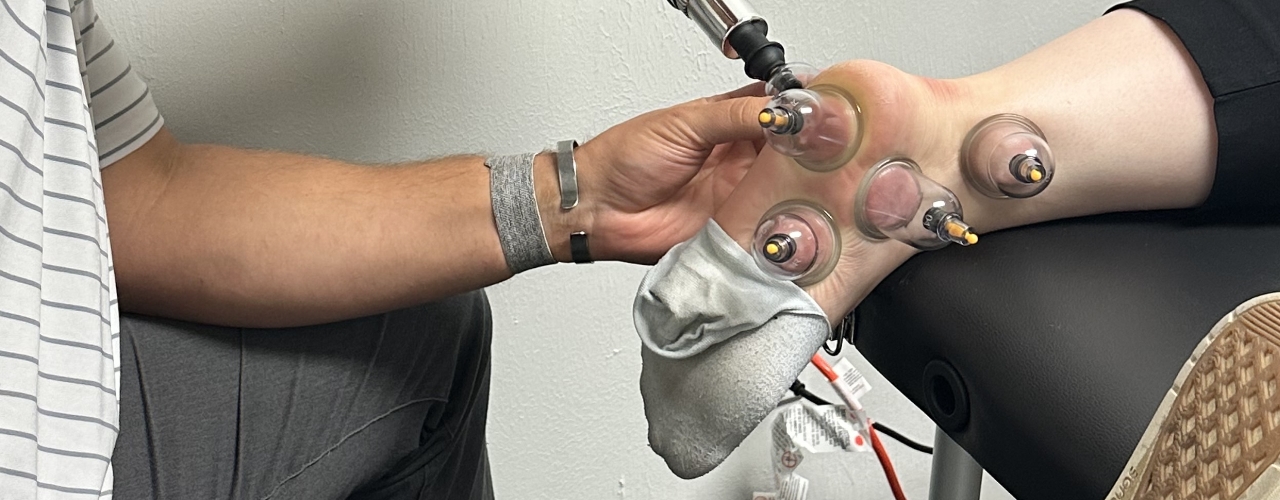
Cupping: A Novel Method of Soft-tissue Release
Are you looking to improve your health and wellness?
A healthy, strong, and active lifestyle is what everyone strives for, and Lamesa Physical Therapy and Sports Rehab can help you achieve desirable levels of health and fitness, all while reducing your pain.
Tissue Distraction Release with Movement (TDR-WM)
The practice of cupping has been used for thousands of years and continues to be a common medical intervention in traditional Chinese medicine. The latest systematic review on cupping concludes that, to date, there is only low-quality evidence indicating that cupping may be effective for reducing musculoskeletal pain.
However, studies to date have only investigated static cupping techniques. Conversely, the novel cupping technique of Tissue Distraction Release with Movement (TDR-WM) involves the gliding of the cups in various directions while the patient simultaneously actively moves the relevant joint and tissues underneath the cup.
During TDR-WM, the negative pressure inside the cup literally lifts and separates the tissue underneath the cup; the addition of active movement of the tissues while the cup is applied may further assist the release of the interfaces between the soft tissues such as skin, fascia, neural tissues, muscles, ligaments, and tendons.
TDR-WM techniques have been clinically observed to be particularly effective in soft-tissue conditions where physical therapy treatments have classically focused on tissue compression. Since TDR-WM is a novel concept, no studies have yet been performed on this approach for the management of myofascial pain.
However, based on clinical experience, patients with persistent myofascial conditions have shown resolution of their symptoms following only a single session of TDR-WM.
TYPES OF CUPPING
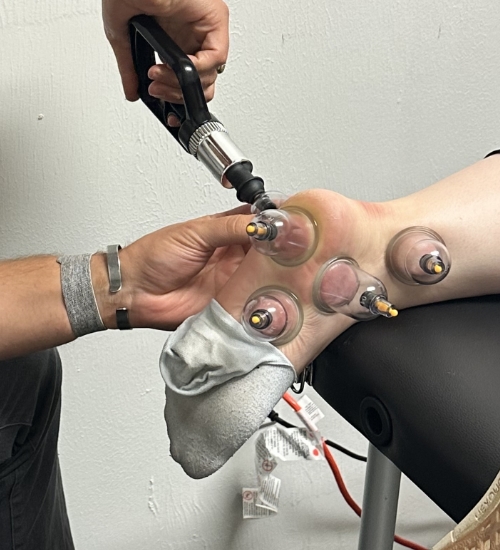
There are two basic types of cupping procedures: wet and dry cupping. The wet cupping procedure involves the making of small incisions on the skin prior to the application of the cups so that when a vacuum is created inside the cup, a significant amount of blood is drawn out. This technique can be considered a form of bloodletting, and will not be discussed any further in this paper.
Dry cupping involves no direct drawing out of any blood, but still involves the creation of a vacuum inside a cup and distraction of the soft tissues, resulting in increased circulation to the skin. This is immediately seen by the redness produced underneath the cups.
One form of dry cupping is referred to as “fire cupping”, where a vacuum is created by burning a small amount of alcohol inside a glass cup which is then quickly placed over the skin. The fire lasts for a very short duration inside the cup creating suction by consuming the air within it. This technique requires some skill in order to be performed safely and effectively.
In ancient times dry cupping was performed using bamboo sticks, animal horns, or metal but in traditional Chinese medicine, glass cups continue to be most commonly utilized.
In recent times, instead of using fire, pumps, and suction guns have been developed to create a vacuum inside glass cups as they are considered easier, more time efficient, and safer to perform.
However, in the past decade silicone cups have also grown in popularity due to their
ease of use. With the advent of silicone cups, some have abandoned fire and suction gun
cupping.
The silicone cups are simply applied over the skin and with a squeeze of the top, a vacuum is produced. Other than being easy to apply, silicone cups are hygienic, easy to clean, and pliable for gliding over uneven body surfaces.
Theoretical Benefits of Cupping
Despite the fact that cupping therapy has been performed throughout the world for over a thousand years, to date there are no proven scientific or agreed-upon benefits of this medical intervention. In ancient times it was hypothesized that “evil spirits” were being sucked out of the body.
In traditional Chinese medicine, it is theorized that when cups are applied over specific acupuncture points it stimulates the flow of Chi (energy).
Since the concept of Chi can be difficult to prove using a Western medicine approach, there have been other theories to help explain the possible therapeutic effects of cupping. Cupping therapy, which is based on creating negative pressure and drawing body tissues outwards, may help…
- Increase local circulation
- Improve lymphatic flow
- Release scar tissue adhesion
- Relax muscle
- Release trigger points
Classical dry cupping is a static technique where several cups are simply left on for 3 to 30 minutes while the patient is passively lying down. Conversely, the primary focus of TDR-WM is to move and glide a single cup in various directions while the patient simultaneously actively moves the relevant joint and tissues underneath the cup.
TDR-WM Contra-indications & Safety
The only known adverse effect from TDR-WM is mild to severe tissue bruising. Limiting
treatment time to 2-3 minutes on the first session can reduce the risk of significant bruising. Treatment time may be gradually increased in future sessions based on patient response.
Some theorize that the bruising is in fact a healthy response to cupping. In traditional Chinese medicine, dark purple bruising post cupping indicates an unhealthy tissue due to stagnant blood but a red bruise indicates a healthy tissue response.
However, in TDR- WM, regardless of color, severe bruises are to be avoided. Significant skin irritations and lesions following static therapeutic cupping have been reported, therefore observing skin response during the performance of TDR-WM is essential to minimize this risk.
- Neural tissue sensitivity (e.g. avoid TDR over the nerve in those with “sciatica”)
- Blood diseases (e.g. Haemophilia)
- Patients on anti-coagulants (“baby” Aspirin excluded)
- Dermatitis
- Open wounds
- Varicose veins
- Hernia
- Severe edema
- Severe health issues (e.g. congestive heart failure, renal failure, etc.)
- Areas near large veins such as the groin region
- Systemic inflammatory conditions (e.g. rheumatoid arthritis)
- Infections (e.g. patient presenting with fever & chills)
- Genital regions
10 STEPS TO EFFECTIVE TDR-WM
- Warm the relevant soft tissue either with 5 minutes of cardio exercise, repeated movements or a heating pad.
- Disinfect the cups with antibacterial soap and warm water between each patient. If the silicone cup feels too rigid, simply rinse it for a few seconds under hot water.
- Inform the patient that they will feel a pull on their skin and muscles as the cup is moved; which will feel quite uncomfortable. They must be warned that pain is inevitable during the technique, but that the pain from the cupping resolves immediately when the technique is stopped.
- Inform the patient that there is a possibility of redness or bruising after the treatment. Although benign, warn them that the bruising may last from a few days to a week.
- Ensure plenty of moisturizing cream is used on the skin to allow smooth gliding of the silicone cups. Without proper skin lubrication, cup gliding will not be possible and very painful if performed on dry skin.
- To attach the cup, use both hands to press down with the thumbs on top while the fingers pull up the edges. The amount of suction is determined by the amount of squeezing. In patients with significant tenderness, start with light pressure then increase the distraction pressure as tolerated.
- The cup may be glided longitudinally, transversely, or in a circular fashion with a gentle distracting force for 2-4 minutes. Brief pause or rest periods may be needed if the patient reports of significant discomfort.
- Guide the patient to actively move the relevant joint(s) in a repetitive pattern that will maximize the soft-tissue movement underneath the cup. The movement is often actively assisted where the therapist guides the movement.
- To remove the cup, simply pull it up on the edge and lift it. Once the TDR is completed, other forms of release, manual therapy, taping, and exercises may still be performed if required.
- If TDR-WM is effective, the patient should immediately report reduced pain and improvement in mobility; if required, TDR may be repeated for another 2-4 sessions (e.g. once a week). If significant improvement is not reported after the first session, future TDR sessions are usually not indicated.
Begin your REHABILITATION JOURNEY plan today!
In the end, an active lifestyle is more than possible, even if you struggle with chronic pain. If you are looking to improve your health, strength, and physical activity, look no further – we are here to help.
Your Next Steps…
Request An Appointment
Receive A Custom Treatment Plan
Work Hard and Progress In Your Recovery
Recover & Enjoy Life Pain-Free!